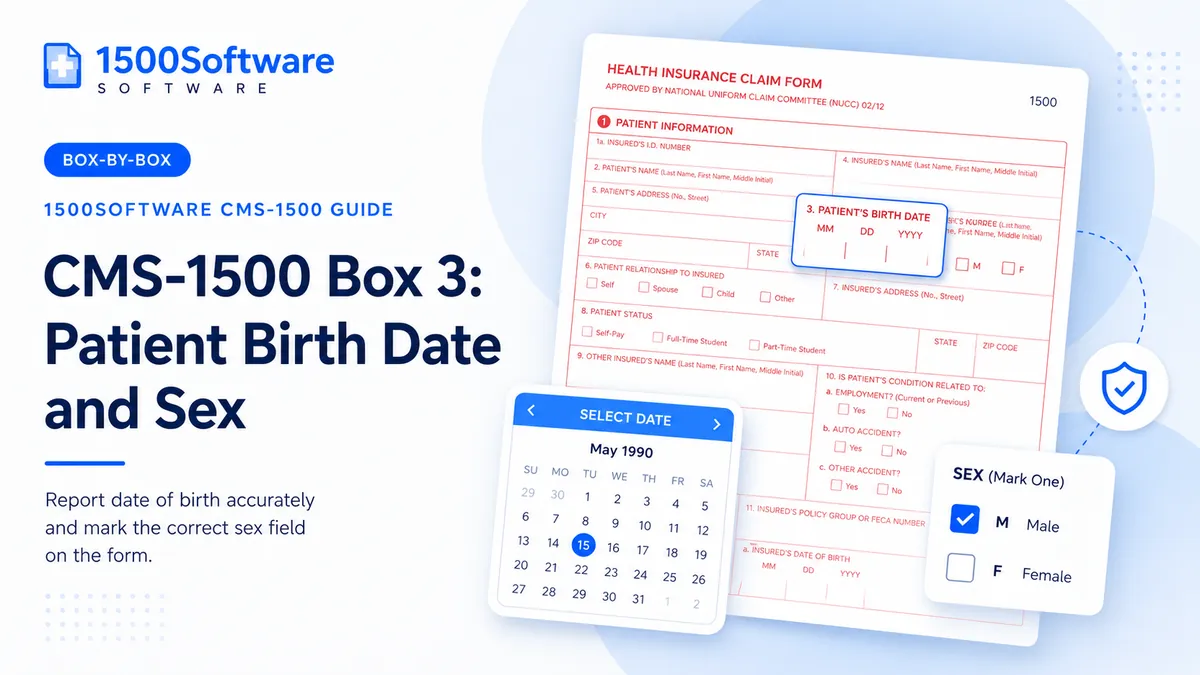
A practical guide to completing Box 3: Patient Birth Date and Sex accurately and consistently.
From our workflow: For Patient Birth Date and Sex, we compare the entry directly with the registration record, insurance card, and current eligibility response. A value can look complete and still be wrong if it came from an old claim or the wrong person’s record.
Report the patient’s date of birth and the applicable form indicator.
For Patient Birth Date and Sex, we also check the related patient, insured, provider, diagnosis, and service-line data. A field can pass a format edit and still be inconsistent with the claim around it.
Why this deserves a careful check
An entry for Patient Birth Date and Sex may be the right length and still be the wrong value. The surrounding coverage, provider, and service information has to support it.
Do not change Patient Birth Date and Sex simply to clear an edit. The value should come from the registration record, insurance card, and current eligibility response, and the correction should be made in the source record when possible.
A practical entry routine
- Identify the person, organization, date, code, or identifier the field is asking for.
- Locate the source document: insurance card, eligibility response, clinical note, authorization, provider enrollment record, fee schedule, or payer remittance.
- Enter the value using the form’s structure and the payer’s required format.
- Compare it with related fields and service lines for consistency.
- Save evidence of the source and the final submitted claim.
What to double-check
- Transposing month and day.
- Using the subscriber’s birth date.
- Leaving an incomplete year.
A prior claim is useful for comparison, but we recheck Patient Birth Date and Sex against the registration record, insurance card, and current eligibility response. Coverage, enrollment, authorizations, codes, and addresses can change between visits.
Final review
- Compare the card, registration, and eligibility response.
- Use the form’s date format.
- Resolve discrepancies before filing.
- Compare the completed claim with the clinical and billing record.
- Confirm the receiving address or electronic route.
- Keep a secure copy and proof of submission.
Using software without skipping review
Software is useful for formatting and consistency checks around Patient Birth Date and Sex, but it cannot create missing documentation or decide a payer-specific value. The source record still controls the claim.
Source material
The sources below describe the national form or transaction framework. Check the payer’s current instructions before filing.