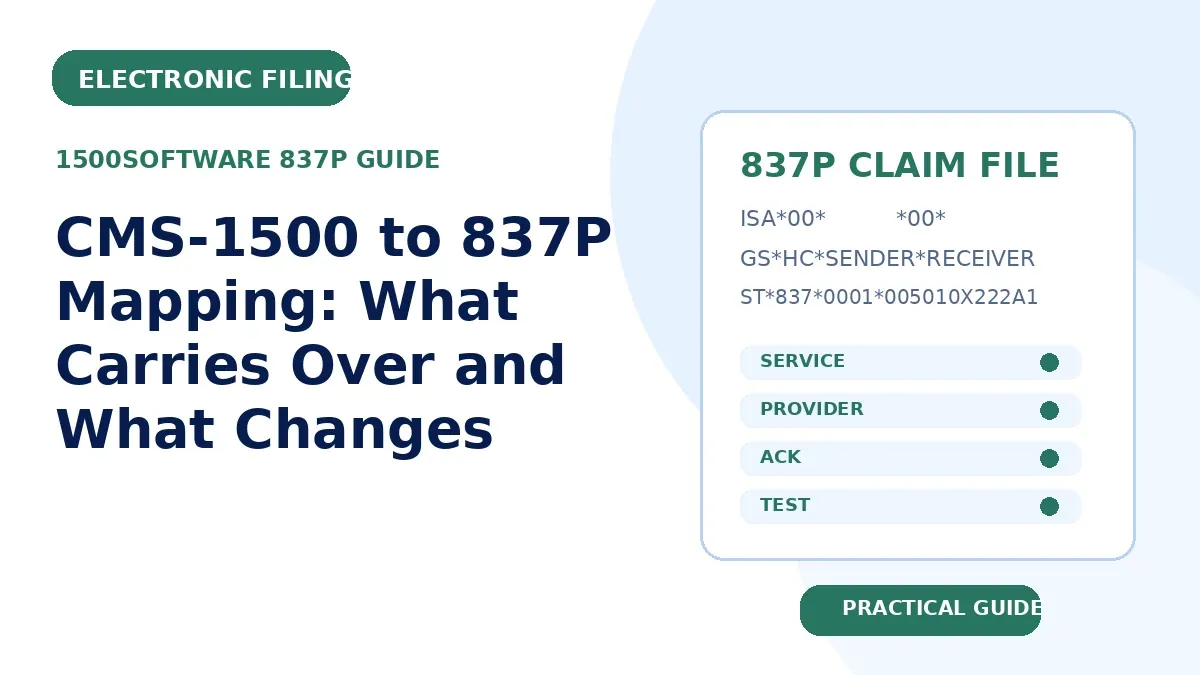
Show how familiar paper-form concepts become loops, segments, and data elements in an electronic professional claim.
From our workflow: An 837P can be structurally valid and still fail a receiver edit. For What Carries Over and What Changes, we check the implementation guide first and then the receiver’s companion guide.
For What Carries Over and What Changes, the 837P must identify each party and service through loops, segments, qualifiers, and control numbers. The receiver cannot rely on the visual layout of a paper form.
What question does this data answer?
Our 837P review for What Carries Over and What Changes begins with the business purpose of the data. We then trace the source field into the loop or segment where the receiver expects it.
Keep the source for What Carries Over and What Changes—such as eligibility, enrollment, authorization, charge data, or the companion guide—alongside the exported value. That makes a rejection traceable without hand-editing the X12 file.
File structure
Show how familiar paper-form concepts become loops, segments, and data elements in an electronic professional claim. The information must remain consistent with related loops and segments. A change made late in the workflow—such as changing the subscriber relationship, diagnosis order, rendering provider, or service line—can require several connected elements to be rebuilt rather than one text value being replaced.
A practical example
The patient name visible in Box 2 becomes a name segment in the appropriate patient or subscriber loop; the value is the same concept, but the electronic file also needs qualifiers and hierarchy.
For What Carries Over and What Changes, our audit trail includes the internal claim ID, destination, file name, control numbers, creation time, claim count, total charges, and every response received.
A practical mapping example
During software testing, we do not map a paper box to a single text position. We map the business meaning to the correct loop, segment, qualifier, and provider role.
CMS-1500 Box 21 diagnosis 1  -> Loop 2300 HI segment
CMS-1500 Box 24D procedure        -> Loop 2400 SV1
CMS-1500 Box 24E pointer "1"      -> SV1 diagnosis pointer
CMS-1500 Box 24J rendering NPI    -> Loop 2420A NM109
CMS-1500 Box 33 billing provider  -> Loop 2010AA
The What Carries Over and What Changes example below uses fictional values. A production file still has to follow the applicable implementation guide and the receiver’s companion guide.
Our release check
- Map roles, not just labels.
- Preserve diagnosis order because service-line pointers depend on it.
- Rebuild connected segments after patient, payer, or provider changes.
How this usually fails
- Assuming every paper box maps to one segment
- Ignoring electronic qualifiers
- Using the printed layout as the only validation source
If a receiver rejects What Carries Over and What Changes, correct the source record, mapping, or generator that produced it. Editing the exported file may fix one transmission while leaving the defect in the software.
Controls that catch subtle errors
- Start with the business meaning of each field
- Identify claim-level versus service-line data
- Verify subscriber and patient relationships
- Test the final file against the receiver rules
A useful validation message for What Carries Over and What Changes identifies the claim or service line, shows the value involved, and explains the relationship that failed. “Invalid file” is not enough for a practical correction.
Continue with these guides
- What Is an 837P File and When Is It Used?
- 837P Pre-Transmission Validation Checklist
- Understanding the 277CA Claim Acknowledgment