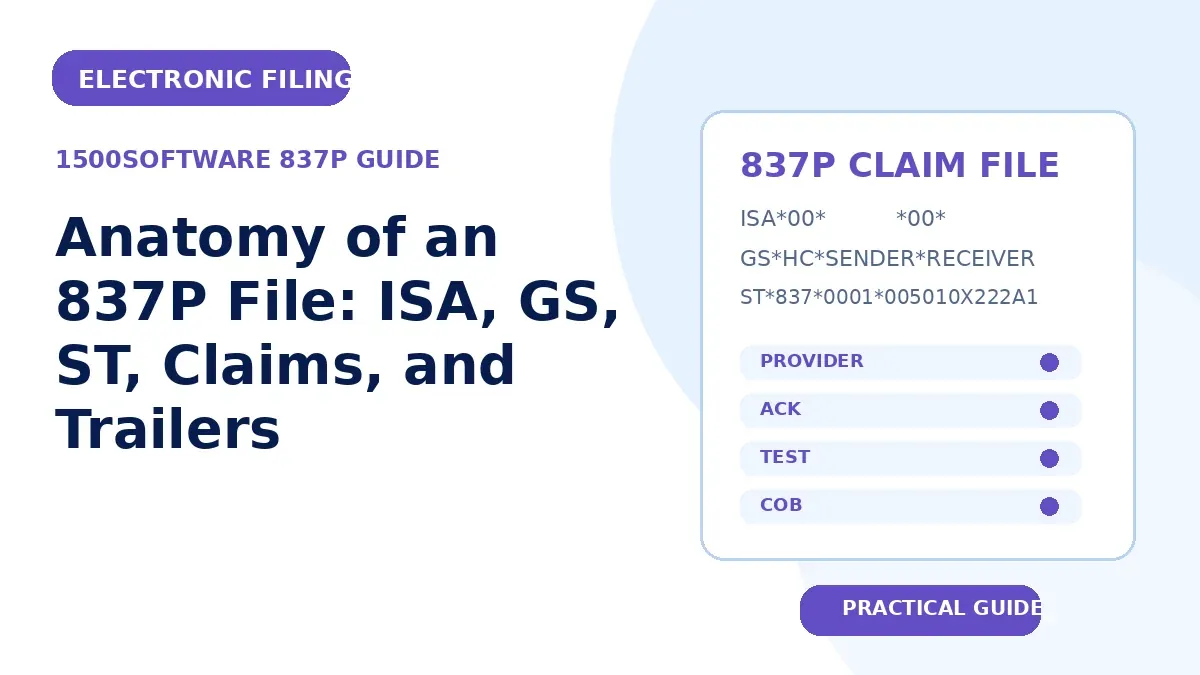
Walk through the envelope structure from interchange to functional group to transaction set and explain why every level must balance.
From our workflow: An 837P can be structurally valid and still fail a receiver edit. For ISA, GS, ST, Claims, and Trailers, we check the implementation guide first and then the receiver’s companion guide.
For ISA, GS, ST, Claims, and Trailers, the 837P must identify each party and service through loops, segments, qualifiers, and control numbers. The receiver cannot rely on the visual layout of a paper form.
Start with what the data is meant to do
Our 837P review for ISA, GS, ST, Claims, and Trailers begins with the business purpose of the data. We then trace the source field into the loop or segment where the receiver expects it.
Keep the source for ISA, GS, ST, Claims, and Trailers—such as eligibility, enrollment, authorization, charge data, or the companion guide—alongside the exported value. That makes a rejection traceable without hand-editing the X12 file.
How the transaction is organized
Walk through the envelope structure from interchange to functional group to transaction set and explain why every level must balance. The information must remain consistent with related loops and segments. A change made late in the workflow—such as changing the subscriber relationship, diagnosis order, rendering provider, or service line—can require several connected elements to be rebuilt rather than one text value being replaced.
Example from a test workflow
One interchange contains one functional group and one 837 transaction set. The control numbers in the opening and closing segments must match at each level.
For ISA, GS, ST, Claims, and Trailers, our audit trail includes the internal claim ID, destination, file name, control numbers, creation time, claim count, total charges, and every response received.
How we trace a claim through the hierarchy
A useful troubleshooting method is to start with the smallest rejected unit and then move outward: service line, claim, transaction set, functional group, and interchange.
Interchange: ISA ... IEA
  Functional group: GS ... GE
    Transaction set: ST ... SE
      Billing provider hierarchy
        Subscriber / patient hierarchy
          Claim: Loop 2300
            Service line: Loop 2400
The ISA, GS, ST, Claims, and Trailers example below uses fictional values. A production file still has to follow the applicable implementation guide and the receiver’s companion guide.
Checks before export
- Count transaction sets before closing the group.
- Count segments before writing SE01.
- Keep claim IDs and control numbers in an audit table.
Where the process breaks down
- Mismatched control numbers
- Missing trailers
- Counting segments incorrectly
If a receiver rejects ISA, GS, ST, Claims, and Trailers, correct the source record, mapping, or generator that produced it. Editing the exported file may fix one transmission while leaving the defect in the software.
Checks that prevent repeat defects
- Validate ISA/IEA
- Validate GS/GE
- Validate ST/SE
- Confirm segment counts and delimiters
A useful validation message for ISA, GS, ST, Claims, and Trailers identifies the claim or service line, shows the value involved, and explains the relationship that failed. “Invalid file” is not enough for a practical correction.
Read next
- What Is an 837P File and When Is It Used?
- CMS-1500 to 837P Mapping: What Carries Over and What Changes
- 837P Pre-Transmission Validation Checklist
- Understanding the 277CA Claim Acknowledgment