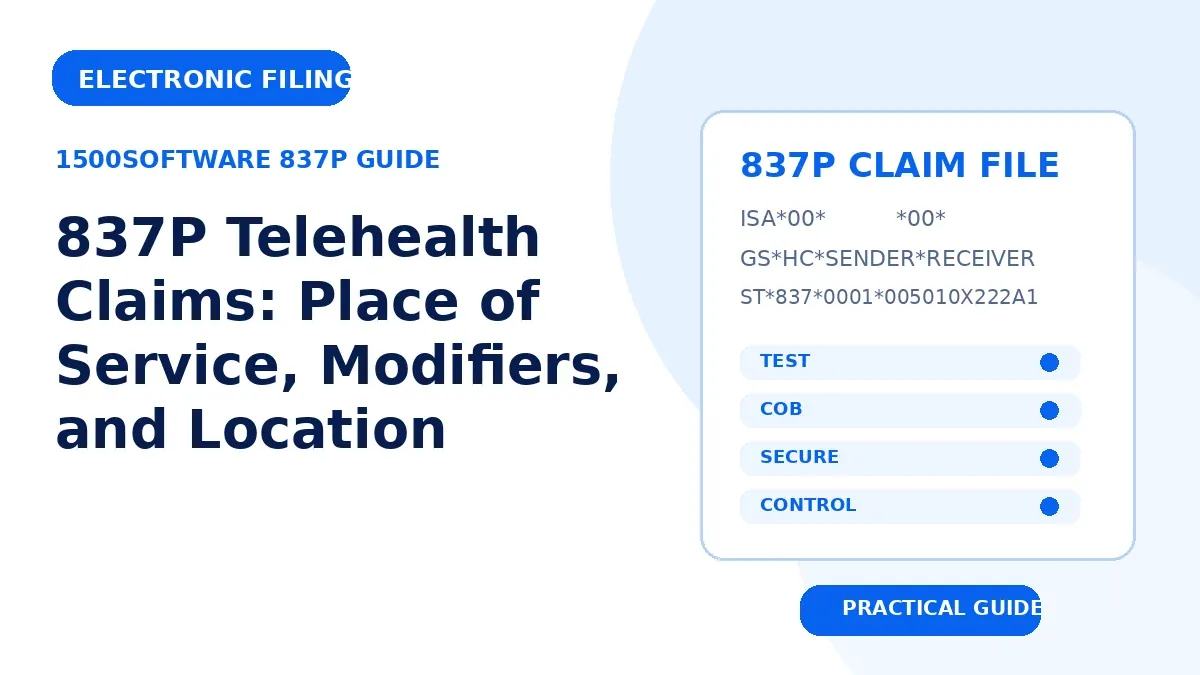
Explain how telehealth variables interact and why payer rules must be checked for each date of service.
From our workflow: In an 837P test file, Place of Service, Modifiers, and Location is checked in context with the surrounding loop, control numbers, and claim totals. A segment that looks correct by itself can still conflict with the rest of the transaction.
For Place of Service, Modifiers, and Location, the 837P must identify each party and service through loops, segments, qualifiers, and control numbers. The receiver cannot rely on the visual layout of a paper form.
What is different about this claim type
Our 837P review for Place of Service, Modifiers, and Location begins with the business purpose of the data. We then trace the source field into the loop or segment where the receiver expects it.
Keep the source for Place of Service, Modifiers, and Location—such as eligibility, enrollment, authorization, charge data, or the companion guide—alongside the exported value. That makes a rejection traceable without hand-editing the X12 file.
Build from the source records
Explain how telehealth variables interact and why payer rules must be checked for each date of service. The information must remain consistent with related loops and segments. A change made late in the workflow—such as changing the subscriber relationship, diagnosis order, rendering provider, or service line—can require several connected elements to be rebuilt rather than one text value being replaced.
Example workflow
A video visit uses the payer-required place of service and modifier. The patient and provider locations are documented and the claim matches the current plan rule.
For Place of Service, Modifiers, and Location, our audit trail includes the internal claim ID, destination, file name, control numbers, creation time, claim count, total charges, and every response received.
Where the process breaks down
- Assuming one national telehealth rule
- Using modifier and POS combinations from an old claim
- Ignoring patient location
If a receiver rejects Place of Service, Modifiers, and Location, correct the source record, mapping, or generator that produced it. Editing the exported file may fix one transmission while leaving the defect in the software.
Checks before export
- Check date-specific payer policy
- Document modality and locations
- Validate POS and modifier combination
- Confirm provider eligibility
A useful validation message for Place of Service, Modifiers, and Location identifies the claim or service line, shows the value involved, and explains the relationship that failed. “Invalid file” is not enough for a practical correction.
Read next
- What Is an 837P File and When Is It Used?
- CMS-1500 to 837P Mapping: What Carries Over and What Changes
- 837P Pre-Transmission Validation Checklist
- Understanding the 277CA Claim Acknowledgment