Workflow
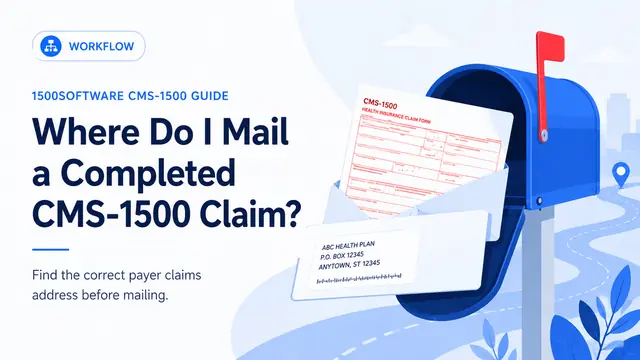
Where Do I Mail a Completed CMS-1500 Claim?
Where Do I Mail a Completed CMS-1500 Claim? Review practical CMS-1500 guidance, common mistakes, payer considerations, and steps for preparing a.
Read guide →Browse 24 practical workflow articles covering CMS-1500 and 837P professional claim workflows.
Gather source information, review the claim, submit it, store acknowledgments, correct errors, and keep a traceable history.
See the paper claim workflowWhere Do I Mail a Completed CMS-1500 Claim? Review practical CMS-1500 guidance, common mistakes, payer considerations, and steps for preparing a.
Read guide →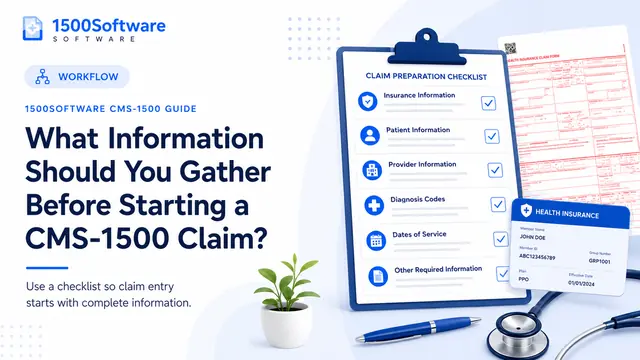
Gather patient, insured, payer, provider, diagnosis, procedure, authorization, and service information before starting a CMS-1500 claim.
Read guide →
How to File a Corrected CMS-1500 Claim. Review practical guidance, common mistakes, payer considerations, and workflow tips for cleaner CMS-1500.
Read guide →
How to Bill Secondary Insurance on a CMS-1500. Review practical guidance, common mistakes, payer considerations, and workflow tips for cleaner.
Read guide →
CMS-1500 Timely Filing Checklist. Review practical guidance, common mistakes, payer considerations, and workflow tips for cleaner CMS-1500.
Read guide →
How to Review a CMS-1500 Before Submission. Review practical guidance, common mistakes, payer considerations, and workflow tips for cleaner CMS-1500.
Read guide →
Learn when a payer may request reports, records, invoices, or other documentation with a professional claim and how to reference it.
Read guide →
How to Back Up CMS-1500 Claim Data. Review practical guidance, common mistakes, payer considerations, and workflow tips for cleaner CMS-1500.
Read guide →
How to Protect PHI When Working With CMS-1500 Claims. Review practical guidance, common mistakes, payer considerations, and workflow tips for cleaner.
Read guide →
How to Create a CMS-1500 Claim Template. Review practical guidance, common mistakes, payer considerations, and workflow tips for cleaner CMS-1500.
Read guide →
How Long Should You Keep CMS-1500 Claim Copies? Review practical CMS-1500 guidance, common mistakes, payer considerations, and steps for preparing a.
Read guide →
A consistent claim-status process helps staff find accepted, pending, rejected, and denied claims before timely filing windows become a problem.
Read guide →
A denial workflow assigns ownership, deadlines, documentation, and appeal steps so unpaid claims do not disappear into a work queue.
Read guide →
Coverage verification reduces avoidable denials by confirming eligibility, benefits, payer routing, and authorization requirements before claim entry.
Read guide →
The claim form summarizes the billing transaction, while the supporting record proves medical necessity, authorization, and the service performed.
Read guide →
Denial reduction depends on accurate registration, eligibility, coding, authorization, claim review, and disciplined follow-up.
Read guide →
A claim control number helps identify a previously received claim for status checks, corrected claims, and payer follow-up.
Read guide →
Coordination of benefits determines the order in which multiple health plans process the same professional claim.
Read guide →
Multiple dates of service can be billed on one claim only when payer rules and service-line detail remain clear and accurate.
Read guide →
Multiple procedures may share a claim, but each line must accurately describe the code, modifiers, diagnosis pointer, charge, and units.
Read guide →
Prior authorization must be obtained, documented, and connected to the claim exactly as the payer requires.
Read guide →
Referral requirements may affect the referring provider fields, authorization data, and claim eligibility.
Read guide →
A pre-submission audit checks patient, payer, provider, coding, authorization, and service-line consistency before the claim leaves the practice.
Read guide →
Year-end review helps practices close unresolved claims, update payer data, preserve records, and prepare for code and policy changes.
Read guide →