Build a claim-entry checklist that prevents interruptions and missing fields.
From our workflow: The practical test for What Information Should You Gather Before Starting a CMS-1500 Claim is whether another staff member can see what was submitted, when it was sent, what came back, and what needs to happen next.
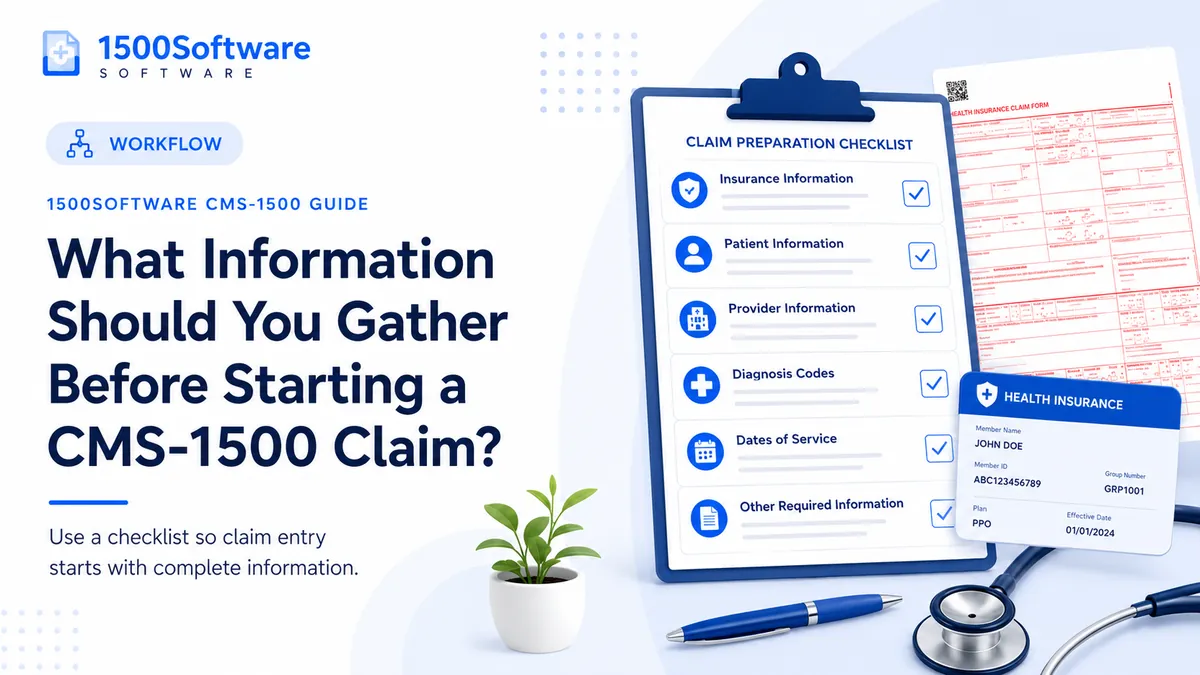
A complete claim begins with accurate registration, coverage, provider, authorization, diagnosis, procedure, date, place-of-service, and charge information. Gathering it first makes review easier.
For What Information Should You Gather Before Starting a CMS-1500 Claim, we keep preparation, review, submission, and follow-up as separate steps. The record should show what was sent, when it was sent, what came back, and who owns the next action.
Why payers care about this value
For What Information Should You Gather Before Starting a CMS-1500 Claim, we also check the related patient, insured, provider, diagnosis, and service-line data. A field can pass a format edit and still be inconsistent with the claim around it.
Do not change What Information Should You Gather Before Starting a CMS-1500 Claim simply to clear an edit. The value should come from the original source record and the receiving payer’s current instructions, and the correction should be made in the source record when possible.
Suggested workflow
- Gather source documents and confirm current coverage.
- Prepare the complete claim from finalized documentation.
- Perform a second review focused on roles, dates, codes, identifiers, units, and totals.
- Submit through the payer-approved method and save proof.
- Reconcile the acknowledgment or remittance and assign follow-up work.
What to double-check
- Starting from an incomplete intake sheet.
- Relying on memory for identifiers.
- Using an expired insurance card.
- Entering codes before documentation is finalized.
Copying an old claim can save time only after the current facts are verified. Recheck What Information Should You Gather Before Starting a CMS-1500 Claim, especially when the payer, provider, or date of service has changed.
Last check before sending
- Collect both sides of the current card.
- Verify demographics.
- Confirm provider and facility identifiers.
- Review authorization.
- Finalize coding.
- Document payments and prior claim references.
- Compare the completed claim with the clinical and billing record.
- Confirm the receiving address or electronic route.
- Keep a secure copy and proof of submission.
Where software helps—and where it does not
A dependable program can reuse stable records and flag inconsistent entries for What Information Should You Gather Before Starting a CMS-1500 Claim. It should not silently guess at information that is absent or uncertain.
Official references
Use these references for the national standard, then compare them with the current payer or clearinghouse guide.