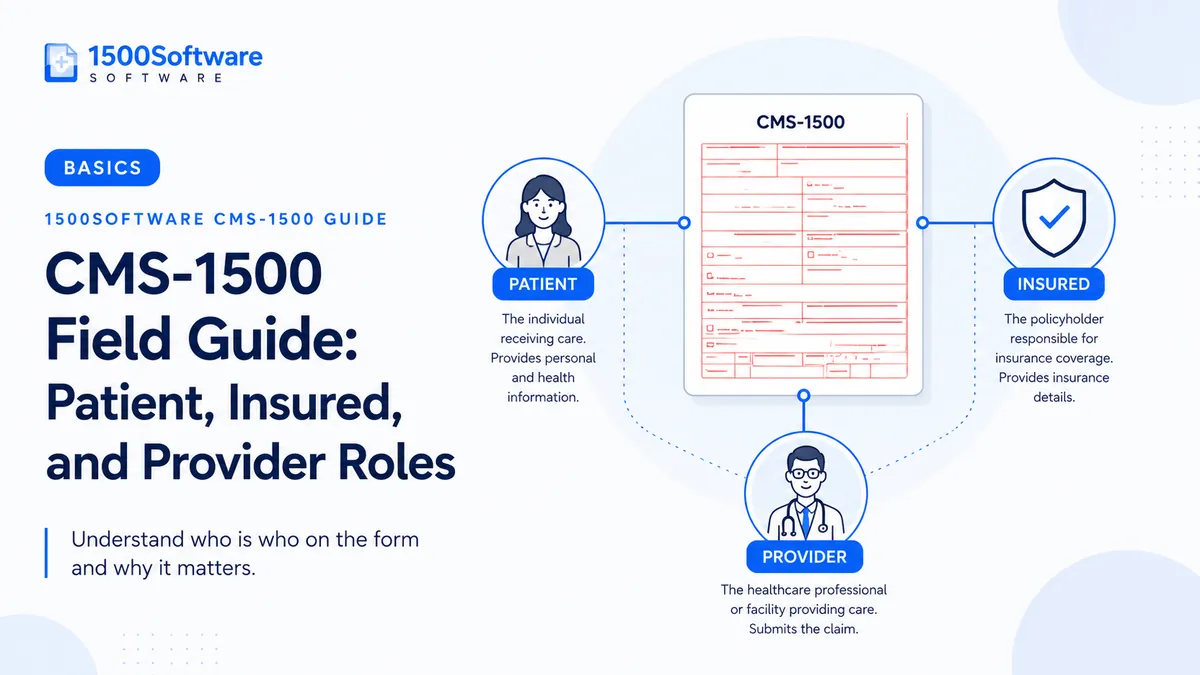
A quick explanation of the people and organizations represented on the claim.
From our workflow: For Patient, Insured, and Provider Roles, keep the patient, insured, provider, payer, and service roles separate. Many claim errors start when two of those roles are treated as the same thing.
The patient receives the service, the insured or subscriber holds the coverage, the rendering provider performed the service, and the billing provider submits the claim and receives claim correspondence or payment as applicable. These roles can overlap, but they are not automatically identical.
The form provides a standard place for Patient, Insured, and Provider Roles, but the payer decides when the field is required and which value is accepted. Use the current payer rule rather than assuming every program handles it the same way.
What can happen when it is wrong
For Patient, Insured, and Provider Roles, we also check the related patient, insured, provider, diagnosis, and service-line data. A field can pass a format edit and still be inconsistent with the claim around it.
If Patient, Insured, and Provider Roles fails an edit, verify the source and the payer rule before changing it. A guessed value can move the problem from rejection to denial.
How to use this guidance
- Identify the payer and claim type.
- Confirm paper submission is permitted.
- Review the current NUCC instructions and the payer manual.
- Prepare and review the claim using source documents.
- Keep a copy and proof of submission.
What commonly goes wrong
- Copying the patient into every insured field.
- Using the group practice NPI as the rendering NPI.
- Putting the service location in the billing provider box without checking roles.
We do not treat the last paid claim as the source for Patient, Insured, and Provider Roles. It may contain information that was valid then and is no longer valid now.
Final review
- Identify each role separately.
- Match names and IDs to enrollment.
- Verify the patient-subscriber relationship.
- Use the payer’s provider-role rules.
- Compare the completed claim with the clinical and billing record.
- Confirm the receiving address or electronic route.
- Keep a secure copy and proof of submission.
What the software should handle
Software is useful for formatting and consistency checks around Patient, Insured, and Provider Roles, but it cannot create missing documentation or decide a payer-specific value. The source record still controls the claim.
Official references
Use these references for the national standard, then compare them with the current payer or clearinghouse guide.