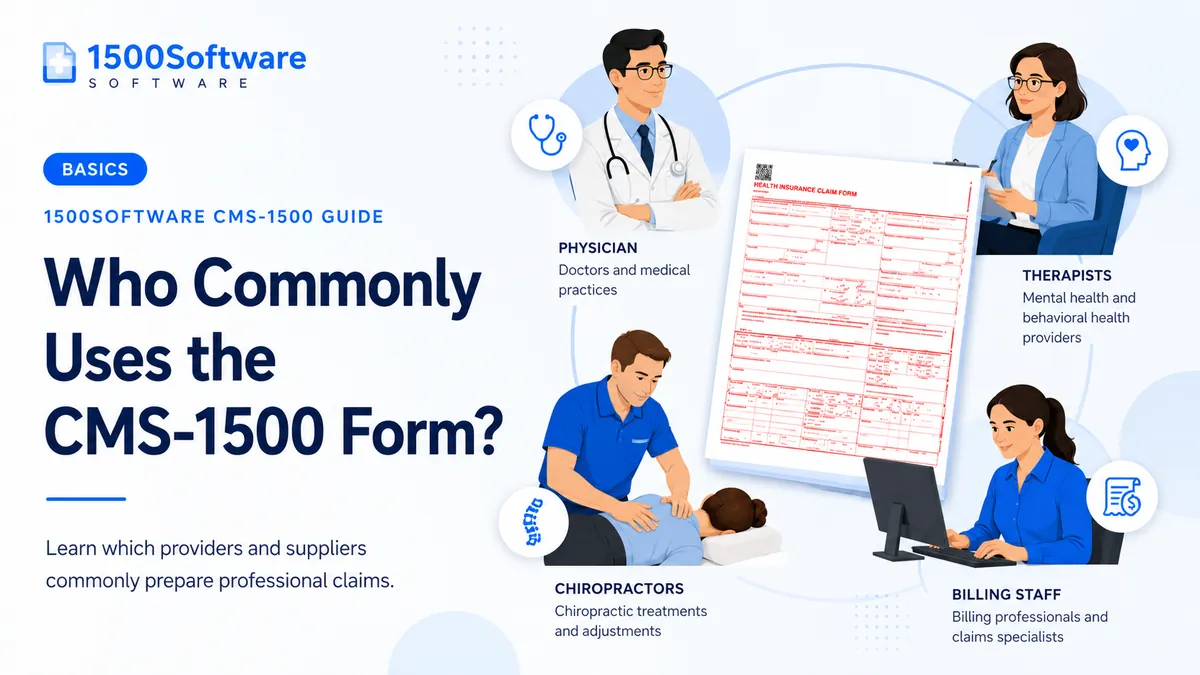
Learn which non-institutional providers and suppliers commonly prepare professional claims.
From our workflow: The easiest way to understand Who Commonly Uses the CMS-1500 Form is to follow one claim from the source record to the paper form or 837P file and then to the payer response.
The form is associated with professional or supplier billing rather than facility billing. Typical users can include physicians, therapists, behavioral health professionals, chiropractors, independent laboratories, and certain suppliers, depending on payer rules.
The form provides a standard place for Who Commonly Uses the CMS-1500 Form, but the payer decides when the field is required and which value is accepted. Use the current payer rule rather than assuming every program handles it the same way.
What can happen when it is wrong
The payer does not read Who Commonly Uses the CMS-1500 Form in isolation. We compare it with the surrounding claim data before deciding the entry is ready.
Passing an edit is not the same as filing an accurate claim. For Who Commonly Uses the CMS-1500 Form, correct the underlying record instead of substituting a value that merely looks acceptable.
How to use this guidance
- Identify the payer and claim type.
- Confirm paper submission is permitted.
- Review the current NUCC instructions and the payer manual.
- Prepare and review the claim using source documents.
- Keep a copy and proof of submission.
Problems we see in claim review
- Assuming every service belongs on a CMS-1500.
- Selecting the form based only on office type.
- Overlooking special payer enrollment or claim-format requirements.
We do not treat the last paid claim as the source for Who Commonly Uses the CMS-1500 Form. It may contain information that was valid then and is no longer valid now.
A quick check before submission
- Identify the billing entity.
- Classify the service as professional or institutional.
- Review the payer manual.
- Confirm whether paper submission is permitted.
- Compare the completed claim with the clinical and billing record.
- Confirm the receiving address or electronic route.
- Keep a secure copy and proof of submission.
What software can check
Software is useful for formatting and consistency checks around Who Commonly Uses the CMS-1500 Form, but it cannot create missing documentation or decide a payer-specific value. The source record still controls the claim.
Source material
These are the national sources we use as a starting point. The receiving payer may add more specific instructions.